Newsletter Subscribe
Enter your email address below and subscribe to our newsletter

 ByJohn A
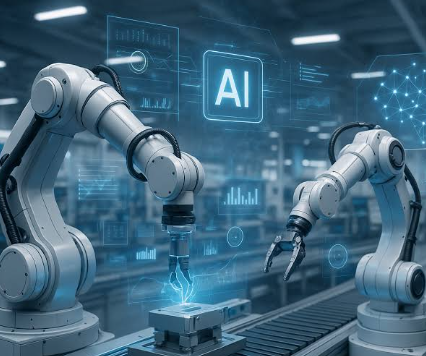
Artificial intelligence in manufacturing automation enables real-time optimization, predictive maintenance, and sharper quality control across production lines. Data governance, digital twins, and edge analytics support scalable, modular implementations that emphasize interoperability and governance. Cross-functional collaboration among engineering, operations, and finance underpins standardized metrics and lean improvement cycles. With ROI benchmarking and structured feedback loops, AI drives data-driven decisions and continuous optimization—yet questions remain about deployment pathways, risk management, and long-term workforce transformation.
Artificial intelligence enhances manufacturing operations by enabling real-time optimization across production lines. Data-driven metrics quantify throughput gains, predictive maintenance reduces downtime, and quality control sharpens process stability.
Scalable deployment follows a modular approach, prioritizing interoperability and governance. Ethical considerations guide implementation, while cross functional collaboration ensures alignment across engineering, operations, and finance, fostering measurable, freedom-supporting improvements without compromising safety or compliance.
See also: kozpicinzi
Selecting AI technologies for automation requires a structured, criteria-driven approach that aligns capabilities with the specific needs of production lines. Decisions rely on measurable impact, interoperability, and scalability. Predictive maintenance guides sensor investments; digital twins enable scenario testing; data governance ensures quality and compliance; edge analytics optimize real-time responses. The result is adaptable, transparent, and resilient automation architecture.
Implementing AI in manufacturing hinges on aligning data quality, infrastructure readiness, and workforce capability with clear performance objectives.
The approach emphasizes data governance as a foundational discipline, ensuring integrity, lineage, and access controls across systems.
Edge analytics enables real-time insight at the source, supporting scalable deployment and adaptive operations while workforce development builds multidisciplinary proficiency for resilient, autonomous production ecosystems.
Measuring impact in manufacturing automation centers on quantifying returns, safety improvements, and ongoing optimization through standardized metrics and disciplined evaluation.
The analysis compares ROI benchmarks across processes, projects, and timeframes, emphasizing reproducible results.
Safety metrics track incident trends, containment efficacy, and risk reduction.
Structured feedback loops, performance dashboards, and lean methodologies enable scalable, data-driven continuous improvement and decision-making across facilities.
Myth vs reality: Common misconceptions persist, such as AI replacing humans entirely or delivering instant perfection. In practice, progress follows iterative improvements. Bias in models requires audits; scalable dashboards reveal performance drift, enabling methodical, data-driven decisions for autonomous, freedom-valuing teams.
Unseen failures are detected via anomaly scoring and fault isolation, enabling predictive resilience. Models incorporate continuous learning and uncertainty estimates, scaling across equipment fleets while preserving interpretability, supporting a data-driven, methodical approach that respects user autonomy and exploration.
AI cannot fully replace human decision-making in shops; instead, it enables workforce augmentation. It supports scalable, data-driven governance, guiding choices while preserving accountability. Ethical considerations (AI ethics) ensure transparent, responsible deployment alongside freedom to innovate.
Hidden costs extend beyond licenses and hardware, as unseen labor and data integration demand ongoing attention, training, and governance. This data-driven, scalable approach reveals systemic frictions, guiding a methodical path toward freedom while preserving control and transparency.
AI governance across multiple plants is maintained through centralized risk governance, standardized data provenance, and unified productivity metrics, enabling scalable predictive maintenance programs while preserving autonomy; dashboards reflect real-time performance, ensuring consistent, auditable decision-making across facilities.
Artificial intelligence in manufacturing automation enables real-time optimization, predictive maintenance, and stringent quality control across interconnected systems. As data governance, digital twins, and edge analytics mature, operations become more predictable, scalable, and compliant, delivering measurable ROI with lean feedback loops. When implemented with interoperable architectures and workforce upskilling, digital factories transform from reactive to proactive ecosystems. Conclusion: AI acts as the compass guiding precision-driven manufacturing toward reliable throughput, where every decision lands like clockwork in a complex, well-orchestrated machine.